
So, October.
This season has always been one of my favorites. The leaves are changing, it is cooling off, and more game nights will happen because people don’t want to be outside. I get to stay in and read books underblanket and cuddle up with my dogs. I love fall, but holy cow, it has descended so quickly this year and I. AM. NOT. READY.
Things in the CLGS and with the Press have been going relatively well. We have had some meetings, plan to have some more, are building some things, and we are doing some other things. . . sorry was that really vague?
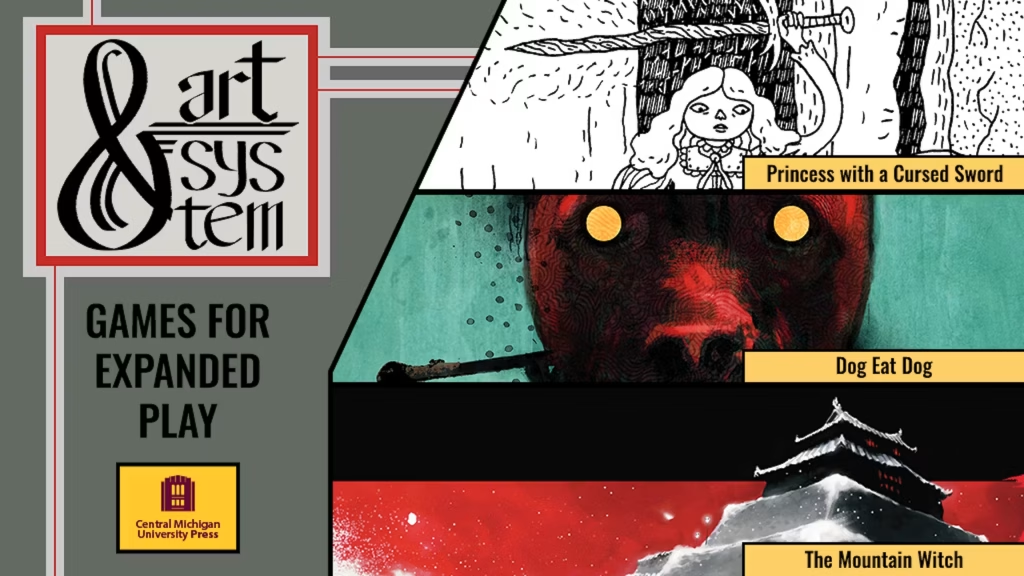
That has been the problem with October: we have been building and building and building, but we can’t quite announce any of the things we are building to the world yet. With one VERY big exception: Art and System. You have probably heard that our new series launched on October 1st. It is awesome, and you should support it.
Break our Games is also back, and we will be meeting again in November, and you should come.

We hope that some of the things we have worked on in September will be ready for an announcement as the month continues to progress. Stay tuned.
Our interview this month is with Co-Director Tracy Davis, aka our Word Witch.
October Spotlight: Tracy Davis, Co-Director
By Liv O’Toole
Tracy Davis describes herself as “a linguist who plays games,” though she’s quick to clarify that she’s “working on becoming a gaming scholar who is a linguist.” Her career and personality both orbit around systems—whether linguistic, numerical, or social—and the patterns that link them. A corpus linguist by training, she thrives on quantitative analysis as much as on wordplay, a trait that shows up in her love of games like Bananagrams and Rummikub. “Maybe I just really like tiles,” she jokes. Outside of her academic work, she’s an avid traveler with a natural curiosity about the world, with plans to visit her sixth continent this year. Her approach to travel mirrors her research approach: immersive, detailed, attentive to the small structures that make up the whole. “I like to spend time in the places I go, soak it up, eat like locals, and discover the odd and obscure. And if I can see it on a train, I am so there for it.”
At Central Michigan University, Tracy serves as co-director of the Center for Learning through Games and Simulations, where she handles the curricular and university-facing side of operations. Her responsibilities range from developing academic programs and navigating the curricular approval process to coordinating events, recruiting, and supporting the team’s broader educational mission. “I’m a vocal advocate for games-based learning and the CLGS in general,” she says, though she prefers the background role—editing, ideating, punning, and troubleshooting. “The point is never to say ‘no,’ but to plan out what would need to be in place to make it happen—and then set those things in motion.” She describes herself as a connector of fragments, someone who sees how the disparate pieces of a project can cohere into something functional, or even elegant.
She’s adamant that what the Center produces—whether a course, an event, or a new game—is never the work of a single individual. “Almost nothing happens because of a single person,” she says. “When people really work together, bolster and support one another, complement and compliment each other, it’s amazing the things that a team can do.” The past few years, she notes, have been “wicked busy,” but the sense of shared purpose keeps her committed. “These are my people. And each and every one of us plays a role in getting things done.”
Tracy’s connection to game-based learning is lifelong, rooted in her earliest experiences with language and family. After earning her undergraduate degree, she joined Teach for America and taught middle school Spanish in rural North Carolina, where she found herself in a pedagogical tradition that had already embraced play as a mode of learning. Later, while completing her Ph.D. in Applied Linguistics at Penn State, she encountered Vygotsky’s Sociocultural Theory, which tied her academic interests in cognition, interaction, and play together. “I may have been predisposed to be open to that kind of teaching and training since I grew up playing games,” she admits. Card games were a family institution: memory with her grandmother at two, double solitaire under the watchful eye of her great-grandmother Zonie, pinochle with grandparents so competitive her grandfather once grounded her for misplaying a hand. “I come to games honestly,” she says, with a mix of humor and pride.
Her arrival at CMU was initially through linguistics and the Teaching English to Speakers of Other Languages (TESOL) MA program, teaching courses primarily for international students. When enrollment shifted and the pandemic eventually shuttered the TESOL MA program and the English Language Institute, she redirected her focus to the emerging Central Michigan University Press and its sibling initiative, the Center for Learning through Games and Simulations. “It was a natural and easy shift for me to start working more with the Center,” she says, the transition reflecting how her background in language, systems, and play found a new home in game design and educational innovation.
Asked which disciplines she sees as part of the Center’s work, Tracy resists narrowing the answer. “Maybe a better question would be which ones aren’t?” she says. For her, gaming sits at the crossroads of almost everything—business, politics, chemistry, engineering, psychology, art, computer science, and music. “There’s a reason the Center includes faculty from all of the colleges,” she points out. “Games bring people together—not just to play, but to create.”
